

Organizations often assume leadership problems can be solved by importing pedigree. In reality, many companies unintentionally create incentives that reward visible transformation over measurable outcomes. The result is a recurring cycle: imported leadership arrives above its actual contribution level, titles inflate to accommodate it, performance frameworks get redesigned to freeze existing builders, institutional knowledge walks out the door, and the executive who orchestrated it vests and moves on — leaving the organization to repeat the same cycle with the next hire.
This article names that cycle, explains the two-arm mechanism that drives it, and assigns specific responsibility to the people who can interrupt it — boards, founders, HR leaders, peer executives, and the executives being hired.
How It Starts
There's a pattern I've watched play out inside promising companies more times than I can count — and it almost never starts in the boardroom.
It starts when an organization encounters a performance gap it doesn't fully understand.
The cause is rarely clear. The pressure to act is immediate. And the system — the incentive structure that governs how leadership responds to that pressure — consistently rewards one thing above all others: visible organizational change.
So the organization does what the system rewards.
They bring in a Director from Google. A VP from McKinsey. A Senior Director from JPMorgan. A GM with a recognizable employer and a title that signals seriousness. The org chart changes. New layers appear. New frameworks get announced. The activity is real. The progress is not.
This is the Pedigree Trap. And it is not primarily a story about individual behavior. It is a story about organizational incentive structures that consistently reward the appearance of transformation over the reality of it — and the predictable damage that follows.
But the mechanism has two arms. And the second one is the one nobody talks about.
The Leadership Replacement Paradox
Before describing the mechanism, name the deeper problem it reveals.
Organizations facing a performance gap almost universally respond by importing leaders who appear to represent the next stage of maturity. The implicit logic is sound: bring in someone who has operated at scale, and scale will follow.
The paradox is this: the executives imported to accelerate growth most often destroy the specific conditions that made growth possible in the first place.
They arrive optimized for a different environment — for managing process inside large, stable institutions, not for building inside fast-moving, context-dependent ones. They bring the tools that worked where they came from: structure, hierarchy, framework, layer. Those tools are not wrong. They are wrong here, now, for this organization at this stage.
And in applying them, they dismantle the thing that actually worked — the speed, the trust, the institutional knowledge, the direct connection between the people making decisions and the people doing the work.
The replacement doesn't fail because of character. It fails because of environment mismatch — and because the organization's incentive structure never required anyone to diagnose that mismatch before making the hire.

This is the paradox boards almost never account for. And it is why the same vacancy gets filled, and emptied, and filled again, every three to four years.
The Two-Arm Machine
The mechanism that sustains this pattern has two arms that operate simultaneously — in opposite directions.
Arm One: Inflate the arrivals. External hires land above their demonstrated contribution level. Titles are generous relative to the work they will actually own. Mandates are strategically broad — designed to be difficult to evaluate rather than easy to measure. Compensation packages are structured to signal commitment, with front-loaded components that create a perception of value before any value has been created.
The org chart acquires new layers. New reporting structures appear. The architecture of the organization begins to reflect the needs of the new arrivals rather than the requirements of the work.
Arm Two: Freeze the builders. Simultaneously — and this is what makes the mechanism self-reinforcing — the performance frameworks for existing employees get redesigned.
New promotion criteria appear. They are complex, multi-dimensional, and require cross-functional sponsorship from leaders who recently arrived and don't yet know the existing team. New calibration processes insert additional layers of management judgment between a contributor and any recognition of their work. New leveling guides re-baseline the entire organization — the engineer who was performing at Senior two years ago is now assessed at Mid-level by the new rubric, without changing a single line of their contribution.
The gate to advancement narrows exactly when the new arrivals walk through a door that was never gated at all.
The existing team is now competing under rules that were written after they arrived — administered by people whose own positions depend on the success of the imported layer above them.
It is asymmetric by design. And because no individual decision looks unreasonable in isolation, it is nearly impossible to challenge through normal channels.
What the Titles Are Actually Saying
Title inflation is not a side effect of this pattern. It is one of its primary instruments — and it operates with precision at every level of the hierarchy.
It starts at the VP layer. The first import arrives. They came from a recognizable institution. Their previous title was Director. But Director here, at this company, feels insufficient — for them, for their compensation expectations, and for the signal the hiring executive wants to send. So they arrive as VP. The title is a one-level gift, justified as "market alignment."
Then the SVP layer appears. The VP needs weight behind them to command the room. Or a second import arrives who was already a VP somewhere else. You cannot bring in two VPs reporting to the same executive without creating a hierarchy between them. So one becomes SVP. Then both do. The SVP title — which did not exist in this organization eighteen months ago — now has two occupants and zero additional accountability attached to it.
Then the EVP layer gets invented. Two SVPs require coordination. Or the struggling executive needs a title that reflects the expanded org they now nominally oversee. The EVP role materializes. It is described as a span-of-control recognition. What it actually represents is a layer inserted between the CEO and the work — a layer that exists to absorb accountability without delivering it.
Then the C-suite of everything. This is where the architecture becomes fully visible to anyone paying attention. The organization now has a CTO of Infrastructure. A CIO of Digital Transformation. A Chief Data Officer of Insights and Analytics. A Chief of Staff to the EVP of Strategic Alignment. Each title carries the prefix of authority. Each role was created to accommodate a person rather than to solve a problem. The "Chief" and "Officer" designations signal enterprise gravity to the board and investors. Inside the building, the people doing the actual work know precisely what each of these roles owns — and what they don't.
None of these titles are fictitious. All of them are on the org chart. Most of them could not answer, in specific operational terms, what they will have built twelve months from now.
Each title serves a different audience simultaneously. To the board, it signals enterprise maturity — depth that substitutes for demonstrated results long enough to survive the next review cycle. To the new arrival, it is a loyalty instrument: their professional identity and compensation are now tied to the person who calibrated their worth so generously, and that obligation does not require explicit coordination to function. To the existing team, the message arrives without words: your years here are worth less than their brand name.
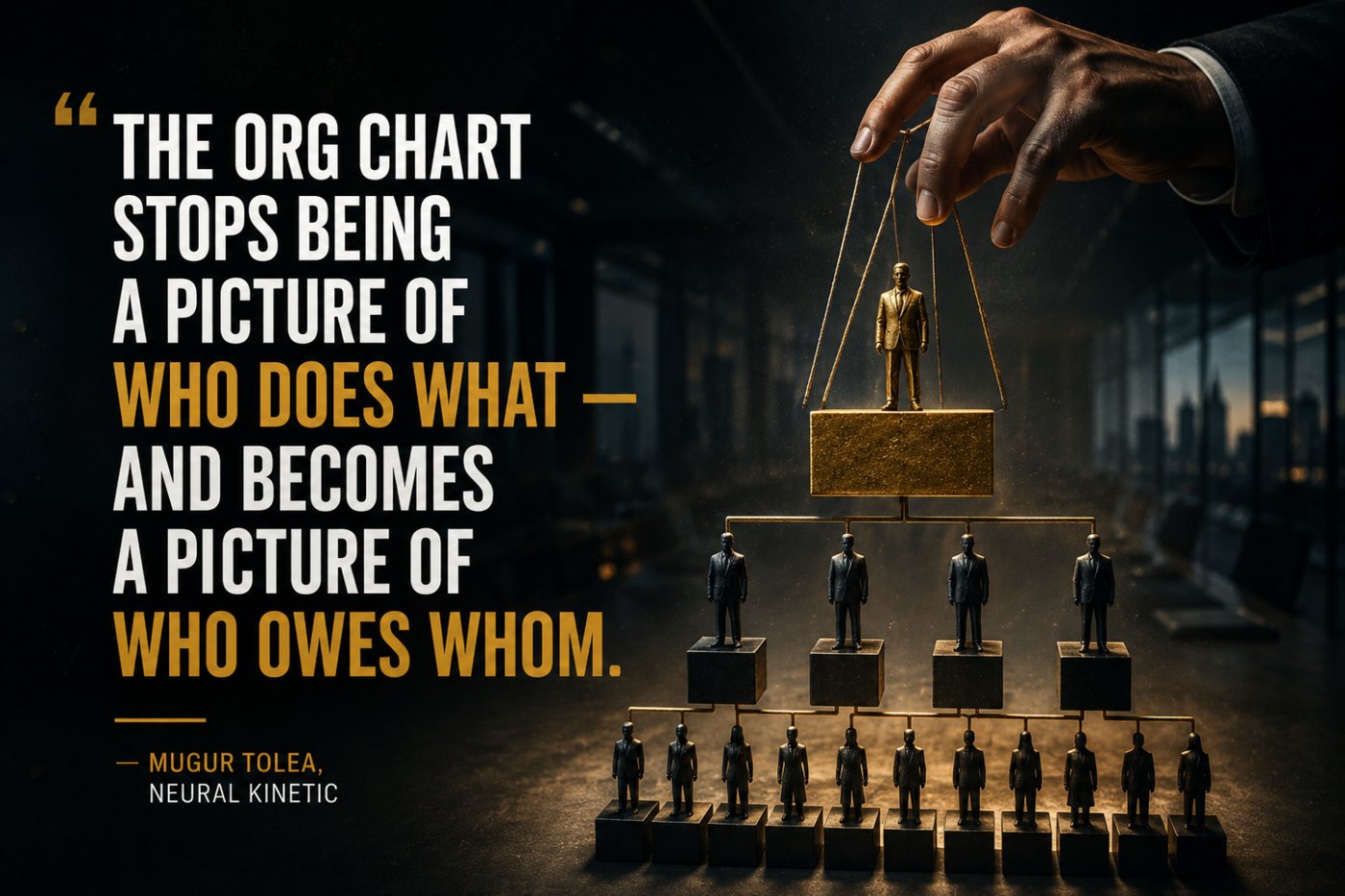
And to the organization as a whole, the org chart stops being a picture of who does what — and becomes a picture of who owes whom.

That is the tell. When accountability no longer aligns with the work — when the people closest to the product, the customers, and the results are no longer in the room where decisions get made — the organization has stopped being optimized for performance and started being optimized for political stability.
The Performance Review as a Weapon
This is the most sophisticated and least visible part of the mechanism — and it deserves specific attention because it is how the machine manages its own resistance.
Struggling organizations don't eliminate their best existing employees directly. That generates legal exposure, visible conflict, and reputational risk. Instead, the system creates conditions in which those employees conclude, rationally and correctly, that they have no future — and depart voluntarily.
The redesigned performance framework is the primary instrument.
It arrives in language that is genuinely progressive. "We're investing in career clarity." "We're aligning our leveling to industry benchmarks." "We want to create consistent standards across the organization." All of this is reasonable on its face. The effect is not.
It moves the goalposts retroactively. Contributions that were previously recognized as strong are now insufficient by the new rubric. The senior engineer who was on track for promotion is now told they need six more months of demonstrated cross-functional influence — a criterion that did not exist in the previous cycle. The product manager who delivered three successful launches is told their strategic scope does not yet meet the bar. The bar moved. Their work did not.
It requires sponsorship from people who cannot provide it. New promotion processes increasingly require endorsement from multiple senior leaders. But the senior leaders who observed and understood the existing team's contributions are either gone or now organizationally distant. The new senior leaders — the imports — have no genuine basis for advocacy. Promotions stall in calibration, year after year, while external hires arrive pre-titled above the process entirely.
It creates documented justification for managed exits. Two consecutive cycles of "meets expectations" in a system recalibrated to make "exceeds" nearly unreachable produces a performance record that makes an eventual departure appear merit-based rather than structural. The paper trail is real. The context behind it is not captured anywhere.
The people this affects read it correctly and quickly. They do not wait for the third cycle. They leave after the first one — the moment they recognize that the evaluation system no longer measures what they do, and that the people administering it have no incentive to change that.
The Institutional Antibody Effect
When the existing team pushes back — when they raise concerns, resist the new layers, or decline to perform enthusiasm for a transformation they can see is hollow — the organizational system pathologizes the response.
What's actually happening is a healthy immune response. The organization is correctly registering that something misaligned has entered the system. The people raising the alarm are almost always the ones with the deepest understanding of the product, the customer, and the actual state of the business.
But the incentive structure — which rewards narrative control and visible momentum — consistently labels this response as the problem rather than the signal.
Organizations that develop the capacity to distinguish between resistance to necessary change and resistance to genuine damage build something resilient. Those that cannot make that distinction keep suppressing the signal until the damage is complete and the people who could have prevented it are gone.
The Phases
Phase One — Manufacture the gap. A capability problem gets named. The team lacks enterprise maturity. The function needs to operate at the next level. The framing is almost never an accurate diagnosis of the actual constraint. It is the justification the system needs to authorize the next phase.
Phase Two — Import and inflate. External hires arrive above their demonstrated contribution level. Titles are generous. Mandates are broad. The org chart acquires new layers. The move gets framed as strategic investment.
Phase Three — Redesign the rules. New frameworks launch across the existing organization. New performance cycles. New promotion criteria. New leveling standards. None of this applies to the imports who arrived pre-titled above the evaluation system. The asymmetry is now structural and self-sustaining.
Phase Four — Push out the builders. The best existing contributors — those with the most options and the clearest view of what is happening — begin to leave. Not terminated. Not managed out explicitly. Made to feel, through a hundred small signals, that the organization no longer has a place for what they actually do. They exit quietly, with gracious departure notes that capture none of what they observed.
Phase Five — Claim the transformation. Sufficient visible change has accumulated to support a narrative of progress. New leadership. New structure. New frameworks. New investment in talent. The board receives this narrative as evidence of momentum. The performance gap that initiated the cycle is now attributed to legacy conditions rather than the response to them.
Phase Six — Vest and exit. The vesting schedule completes. The executive moves on, reference-checked by a network of people whose own positions were created by the same pattern. The organization begins the process of diagnosing what happened and filling the vacancy — often by repeating the same cycle.
How to Stop It — And Who Is Responsible
The pattern survives not because it is invisible but because responsibility for interrupting it is distributed across multiple stakeholders — each of whom assumes someone else is watching. No one is watching. That assumption is what the machine depends on.
Here is who owns what.
The Board and CEO: Measure Outcomes, Not Org Charts
The board's failure mode is consistent: executive performance gets evaluated through the executive's own reporting. Org charts, headcount growth, framework launches, and hiring announcements are presented as evidence of transformation — and accepted as such.
They are evidence of activity. Activity and progress are not the same thing.
Require outcome accountability that is product and customer facing. Not "we've strengthened the leadership team." What shipped? What grew? What measurably improved for the customer in the last twelve months? If an executive cannot answer those questions with specifics after a year in the role, that is a performance conversation — not a prompt for another strategic hire.
Treat attrition as a leading financial indicator. When experienced, long-tenured contributors leave at elevated rates, the board is not observing a culture event. It is observing an early signal of organizational damage that will appear in product velocity, customer retention, and revenue metrics twelve to eighteen months later. By the time it shows up on the P&L, the institutional knowledge is gone and the damage is not reversible by any executive hire.
Commission independent talent health audits. Not conducted by HR, which reports to the executive under review, but by an independent party with direct access to contributors at multiple levels. Ask specifically: who has been stalled in promotion for more than two cycles, and why? What changed in the performance framework in the last eighteen months? What is the tenure profile of recent voluntary departures?
HR and People Leadership: Audit for Asymmetry Before It Launches
HR is frequently not the architect of this pattern. But it is often its operator — administering the performance frameworks, running the calibration cycles, processing the title grants. That operational role carries genuine responsibility.
Audit every new performance framework for asymmetric impact before it launches. The specific question: does this framework apply uniformly to all employees at the relevant level — including recent external hires — or does it create a structurally protected class of imports who arrived above the evaluation system? If the answer is the latter, the framework is a political instrument. HR must refuse to administer it in that form.
Track title grant patterns independently. When external hires consistently land one to two levels above internally promoted equivalents performing comparable work, that is a compensation equity problem with legal exposure — not just a culture concern. HR has the data. HR has the obligation to surface it.
Build a genuine escalation path for contributors who believe their evaluation has been manipulated. Not a formal grievance process that routes back through the management chain creating the problem — a direct channel to senior HR leadership or a board-level audit function that can investigate without organizational interference. The people living inside this pattern rarely speak because there is no safe place to speak. Build it.
Track internal promotion velocity as a named metric. If the same rigor, speed, and organizational advocacy applied to external senior hires were applied to advancing internal contributors performing at equivalent levels, the pipeline would not stall. Make it measurable. Report it.
Peer Executives: Name What You See
Peer executives are rarely running this pattern. But their silence is what allows it to survive longer than it should. That silence is a choice — and in organizations where this is active, it is one of the most consequential choices being made.
Ask the accountability question on the record. When a colleague announces a new senior hire with a broad mandate and an elevated title, the right question — asked professionally, directly, and in the leadership forum where the announcement is made — is: what specifically will this person build, and how will we evaluate it in twelve months? That question is not aggression. It is governance. Normalize it.
Advocate for builders you can see being sidelined on other teams. Cross-functional visibility is one of the few structural advantages a peer executive holds that affected contributors do not. Use it.
If you observe that an exceptional contributor on another team is being systematically excluded from advancement, say so — to HR, to the CEO, to the board if necessary.
Be honest in reference conversations. The professional norm of generous exit references is a significant part of the supply chain that moves this pattern from one organization to the next. Every unqualified positive reference for an executive who left an organization damaged is a transfer of that damage to the next company. Honesty in references is not disloyalty. It is institutional responsibility.
The Executive Being Hired: Earn the Title Before You Wear It
If you are moving from a large, established institution into a smaller or faster-moving organization — and you are arriving with a title that exceeds what the people who built the place currently carry — you have a decision to make in the first ninety days.
You can use the title as authority: build the layer, import the network, redesign the frameworks, run the playbook. Consciously or not, because it is the only operating culture you have ever known.
Or you can earn the title.
Earning it means spending the first ninety days understanding before announcing. Learning what was built before you arrived, why it was built that way, and who built it. Identifying the people who carry the institutional knowledge — and treating them as an asset rather than a threat. Setting a specific, public, measurable commitment for what you will deliver in year one. Not what you will organize. What you will ship.
The leaders who come from large organizations into smaller ones and leave them genuinely stronger share a specific quality: they arrive with intellectual humility about what they do not yet know, and they build their authority from demonstrated results rather than imported title. That leader exists. They are not the one this pattern describes. And organizations would be well served to know, before the offer is signed, which one they are actually hiring.
Founders and Investors: Protect What You Built
You have a stake that no governance structure fully captures. The people who built your company in the early years did so with belief — in the product, in the mission, in the idea that what they were doing was worth doing. That belief is the substrate of everything that followed. It is extraordinarily fragile once broken, and it does not recover through a new organizational announcement.
Stay close enough to the actual work to know when the people doing it are leaving — and why. Not through dashboards. Not through the executive's update. Through direct conversations with contributors who have no incentive to manage your perception of what is happening.
Treat elevated voluntary attrition among long-tenured employees as a five-alarm signal. These are not people who leave casually. They stayed through hard periods because they believed. When they stop believing, the organization is losing something that no external hire can replace — and the effects will appear in the numbers six quarters from now, long after the departure pattern was first visible.
Make the internal candidate question mandatory before any senior external hire. Was an equivalent internal candidate considered? What was the outcome of that consideration, and why? Not as a formality — as a genuine gate. The answer to that question, and the quality of reasoning behind it, tells you most of what you need to know about how the hiring decision is actually being made.
You built something real. Protect it with the same seriousness you applied to building it.
The People Already in the Room
Before any organization imports another credentialed name, someone needs to ask the harder question: why isn't the person who has been building this for four years being given the opportunity to lead it?
In almost every organization I've worked with, there is someone — often several someones — carrying the actual work. They understand the product at a depth no external hire reaches in eighteen months. They have earned customer trust that does not transfer with a new title. They have solved hard problems without adequate recognition, resources, or protection.
They are not polished presenters. They may not have a recognizable employer in their recent history. They have something more durable: they know what is actually true about the organization — its capabilities, its constraints, its customers, and its potential.
These contributors become invisible to an organization running this pattern precisely because their competence makes the pattern harder to sustain. The system's response is to hire around them, title above them, redesign the frameworks that would otherwise advance them, and wait for the resulting frustration to produce a departure that can be described as a personal choice.
The organization's interest is the exact opposite.
Promote them. Pay them what the external hire would have cost. Design the evaluation framework to measure what they actually do. If they have genuine development needs, invest in those specifically and directly.
They will not require eighteen months to understand the product. They will not build a political buffer layer to feel secure in the role. They will not depart the moment the compensation structure vests.
A logo on a resume is not proof of leadership. It is proof of employment.
The person who has been building your organization without the logo — they deserved the title before any of this started.
The Question That Determines the Next Decade
Every organization eventually faces a version of this choice — rarely out loud, almost always through a series of smaller decisions that accumulate quietly into a direction.
Do you protect the people who built the company — or the system that rewards the appearance of having upgraded it?
Do you measure what was shipped — or what was announced?
Do you ask what your SVP of Strategic Transformation has actually delivered — or do you accept the org chart as evidence of seriousness?
The organizations that ask these questions and answer them honestly build something that compounds. They retain the people who know what is true. They advance the people who do the work. They build the kind of culture that attracts builders — and builders, when given the conditions to build, produce the only results that actually matter.
The organizations that don't keep filling the same vacancy every four years. They keep watching their best people leave for organizations that recognize what they have. They keep absorbing the cost — in delayed roadmaps, in eroded customer relationships, in morale that never quite recovers — of a pattern they never named clearly enough to interrupt.
The org chart changes. The titles change. The executive moves on.
The playbook doesn't.
Mugur Tolea is Founder and Executive Advisor at Neural Kinetic, an AI strategy and digital transformation advisory practice. He has led technology at scale across financial services, e-commerce, and media — and has watched this pattern run to completion more times than he'd like.