Every board I speak with is asking the same question: how quickly can we deploy AI to reduce costs? It is the right question to ask. It is not, however, the only question that matters — and the ones being left unasked are accumulating into a liability that forward-thinking executives should be getting ahead of now, before regulators, employees, and customers force the issue.
The question boards are not asking is this: which AI deployments are strategically sound over a five-year horizon, and which are creating organizational and regulatory risk that will cost more than they save? The distinction matters enormously, and most organizations currently have no framework for making it.
Concern about AI eliminating jobs is not new. Economists Carl Benedikt Frey and Michael Osborne estimated in their landmark 2013 Oxford study that nearly half of U.S. jobs were at high risk of automation within two decades. What is new is that we have crossed from prediction into consequence. The systems that were theoretical in 2013 are operational today, and the workforce displacement is measurable. That shift from future risk to present reality changes the strategic calculus for every organization deploying AI at scale.
Two Kinds of AI Investment — and Only One Creates Durable Value
Not all AI deployment is equivalent from a strategic or risk perspective. MIT economist Daron Acemoglu and others have drawn a rigorous distinction between AI that augments human workers — making them dramatically more capable — and AI that substitutes for them, simply replacing a human with a cheaper machine. The distinction has implications far beyond labor economics. It maps directly onto the question of which AI investments create durable competitive advantage versus which generate short-term cost savings while accumulating longer-term risk.
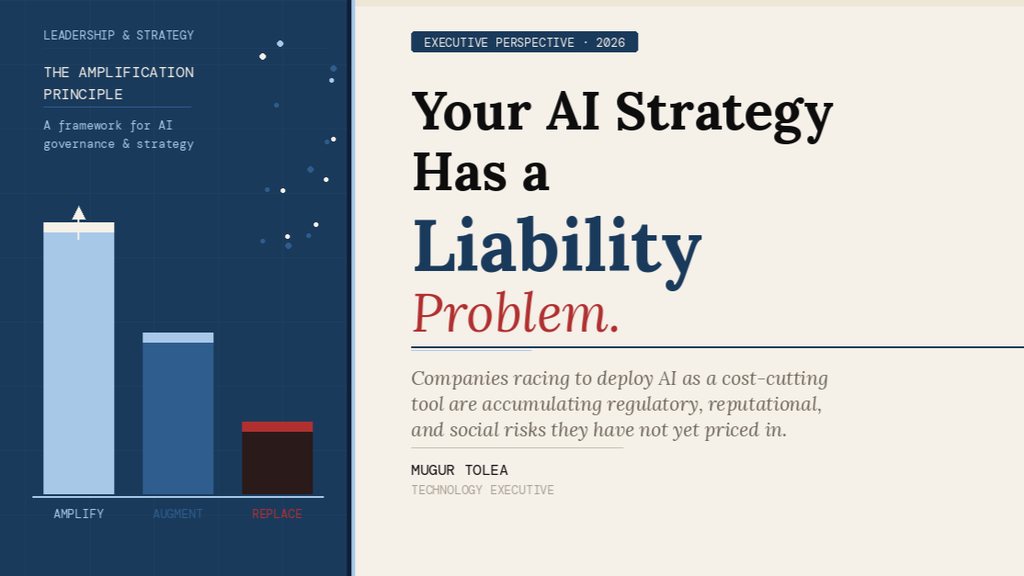
I propose a practical test I call the Amplification Principle: an AI deployment is strategically sound when it enables capabilities that did not previously exist at human scale, or multiplies individual human output by an extraordinary factor. It is strategically questionable — and increasingly, legally and reputationally risky — when it simply substitutes for a worker doing a task that was already being done.
The distinction is not always clean, but it is usually honest. AI that enables a single analyst to synthesize ten thousand data points simultaneously, surfacing insights no team of analysts could produce in the available time — that is amplification. It creates value that would not otherwise exist. AI that replaces the analyst entirely while the work product remains approximately the same — that is substitution. The cost saving is real, but so is what is being created in its wake.
AI that amplifies — lower risk
- Drug discovery across billions of molecular combinations
- Real-time synthesis across 100+ data sources simultaneously
- Predictive modeling at resolutions no human team could compute
- One engineer reasoning across an entire codebase at once
- Customer insight generation at population scale
- Risk detection across millions of transactions in real time
AI that substitutes — higher risk
- Replacing paralegals drafting routine contracts
- Eliminating customer service agents with chatbots
- Reducing marketing headcount through AI-generated copy
- Automating accounting roles to cut the finance team
- Replacing junior analysts with AI-generated reports
- Using AI-generated content to reduce editorial staff
The One Million Factor
A useful mental model for any executive evaluating an AI investment: ask whether this system makes one person capable of doing the work of roughly a million — surfacing insights, processing data, or solving problems at a scale no human team could match. That is amplification. Or does it simply make one person redundant in favor of a machine doing the same work that was already being done? That is substitution.
The former opens genuinely new frontiers and creates competitive advantage that compounds. The latter transfers value from workers to shareholders, generates savings your competitors will replicate within eighteen months, and — as the regulatory environment hardens — accumulates a liability you have not yet priced in.
If you cannot honestly say your AI deployment moves the needle by at least an order of magnitude in what is possible — not just in what it costs — it deserves a harder look before you proceed.
The Risk Your Legal Team Should Already Be Modeling
The regulatory environment around AI-driven workforce displacement is moving faster than most corporate legal and compliance functions have absorbed. The European Union's AI Act, now in force, establishes accountability frameworks that extend to employment impacts. Legislative proposals in multiple U.S. states are beginning to address automation-related displacement directly. The direction of travel is clear, even if the specific instruments are not yet settled.
The idea of a tax or levy on organizations that automate away human jobs has been in serious policy circulation since Bill Gates argued for it explicitly in 2017, reasoning that if a human worker pays income tax on their labor, a machine performing the same function should trigger a comparable public contribution. The European Parliament debated the concept around the same period and declined to adopt it — partly due to industry lobbying, partly due to genuine implementation complexity. The idea was shelved, not resolved. What has changed since 2017 is the scale of the systems involved. A factory robot displacing one assembly worker is a contained event. An AI platform simultaneously eliminating knowledge worker roles across an entire industry sector is categorically different in its fiscal and social impact, and policymakers are beginning to treat it that way.
Organizations that have been quietly eliminating headcount through AI substitution while lobbying against any accountability framework are taking a bet that the political environment will not shift. That bet is becoming harder to justify.
A Displacement Tax: What It Would Look Like and How to Get Ahead of It
Whether enacted by governments or adopted voluntarily as a governance standard, a displacement levy on AI substitution deployments follows a straightforward logic: when an organization eliminates positions because AI has made those workers economically redundant, it has captured a productivity gain while externalizing the cost — in the form of unemployment support, retraining expenses, and social safety net burdens borne by the public and the displaced workers themselves. A displacement tax corrects that externality by requiring the organization generating the gain to fund the transition it creates.
How it would work
Organizations deploying AI that results in measurable workforce reduction — beyond normal attrition — would be assessed a levy based on workers displaced, their average prior compensation, and duration of expected displacement.
Revenues would flow into a dedicated Displacement Transition Fund — ring-fenced from general government revenues — to fund income replacement during transition and retraining for roles less susceptible to AI substitution.
Organizations deploying AI in genuine amplification roles would qualify for reduced or zero assessment, provided they can demonstrate deployment expands rather than eliminates human economic participation.
Illustrative formula: Annual Levy = Workers Displaced × Average Annual Compensation × Displacement Factor (Displacement Factor: 0.0 = pure amplification → 1.0 = pure substitution, determined by independent audit). Fund Benefit = Up to 80% of prior earnings for a period proportional to years worked, plus retraining allocation.
This design differs critically from the Universal Basic Income proposals that Andrew Yang championed in 2020 and the broader income floor arguments made by economists like Martin Ford in Rise of the Robots. Those frameworks stalled politically because they were framed as permanent entitlements funded by general taxation — obligations for everyone, regardless of culpability for the displacement. A targeted displacement levy is different in a way that makes it both more politically viable and more economically defensible: the organization generating the gain funds the transition it creates. The contribution is proportional to the displacement. The benefit is proportional to what was lost. That symmetry is something regulators, unions, and the public can accept in a way that broad redistribution schemes cannot achieve.
What Forward-Thinking Boards Are Already Doing
The organizations best positioned for this environment are not waiting for regulation. They are building governance frameworks now that will give them defensible positions when — not if — the regulatory environment hardens. Several practices are emerging among the more sophisticated actors.
01. AI deployment classification — Formal internal categorization of AI investments as amplification or substitution, with different approval thresholds, risk assessments, and disclosure standards for each category. Substitution deployments trigger additional governance review before sign-off.
02. Workforce impact assessments — Pre-deployment analysis of labor displacement effects, analogous to environmental impact assessments — conducted before deployment decisions are finalized, not after headcount reductions are announced.
03. Voluntary transition funding — Some organizations are establishing internal displacement funds proactively — funded from AI productivity gains — to support affected workers. This positions them favorably with regulators, employees, and the public regardless of what mandatory frameworks emerge.
04. Transparent public reporting — Disclosing AI deployment impacts on workforce composition in annual reports and ESG filings — getting ahead of mandatory disclosure requirements that are coming in multiple jurisdictions.
05. Regulatory engagement — Participating constructively in policy development rather than defaulting to opposition lobbying. Organizations that help shape workable displacement frameworks will have more influence over their design than those who simply resist.
Five Questions for Your Next Board Agenda
- What percentage of our current AI investments are amplification versus substitution, by the definition above? Do we actually know?
- What is our exposure if a displacement levy at 50% of displaced worker compensation is enacted in our primary jurisdictions over the next three years?
- How are we disclosing AI-related workforce impacts, and how does that disclosure compare to emerging regulatory expectations in the EU and leading U.S. states?
- What is our reputational position with customers and prospective employees on AI and workforce — and how would it shift if our substitution deployments became a story?
- Do we have a voluntary transition commitment for workers displaced by AI that we could articulate publicly and defend under scrutiny?
The Strategic Case for Getting Ahead of This
There is a straightforward business case for the amplification principle that goes beyond ethics or regulatory risk. Organizations that deploy AI primarily as a substitution tool — eliminating headcount to capture short-term cost reductions — are making a different kind of bet than organizations that deploy AI to do things they could not previously do at all. The former generates savings that competitors can replicate as soon as they run the same playbook. The latter generates capabilities that are genuinely differentiated and that compound over time.
The company that uses AI to enable a single researcher to synthesize the global scientific literature in their field and identify previously invisible connections has built something. The company that uses AI to reduce its research team headcount by thirty percent has cut costs that its competitors will cut by the same amount within eighteen months — and has accumulated the reputational and regulatory liability in the process.
The direction this technology should be pointed — toward expanding what organizations and individuals can do, not toward simply doing the same things with fewer people — is not just an ethical position. It is the better long-term strategy. And it is the position that will age best as the regulatory and social environment around AI workforce displacement continues to harden.
The technology is extraordinary. The organizations that direct it toward genuine amplification — and govern the transition costs of substitution honestly — will be the ones that look back on this moment as having made the right call.
Mugur Tolea is a Technology Executive with direct experience designing and deploying AI systems at scale. This article draws on research by Daron Acemoglu (MIT), Carl Benedikt Frey and Michael Osborne (Oxford), and the policy work of Andrew Yang and Martin Ford on automation and labor displacement.