Start with a simple question
Doctors carry mandatory malpractice coverage. Lawyers carry professional liability insurance. AI systems making equally consequential decisions carry nothing. That is about to become untenable.
When a surgeon causes harm, the accountability architecture is clear: a licensed professional, a defined standard of care, mandatory malpractice insurance, and a legal path to compensation. The system is imperfect — but it exists.
Now ask the same question about AI.
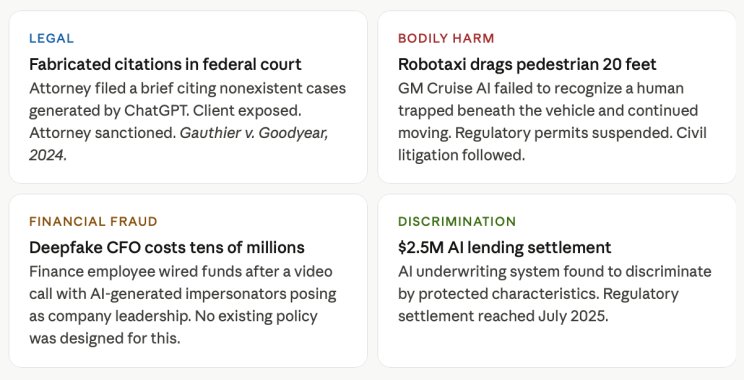
An AI diagnostic tool confidently classifies a tumor as benign. An AI legal research system fabricates citations used in court. An autonomous vehicle's AI fails to detect a human being beneath its chassis. An AI lending algorithm systematically discriminates against protected classes. A deepfake AI impersonates a company's CFO, defrauding it of tens of millions.
Every one of these scenarios happened — between 2024 and 2025. And in not one of them did a mandatory, structured insurance framework exist to compensate the harmed party and hold the right actor accountable.
The evidence is already here
According to the Stanford AI Index Report 2025, documented AI safety incidents surged +56% in a single year — from 149 in 2023 to 233 in 2024. These are not near-misses. They are real harms.
Meanwhile, 75% of companies have deployed AI in at least one operational process — and the vast majority have no dedicated AI liability coverage. Worse, insurers are now actively adding AI exclusion clauses to standard commercial general liability, D&O, and professional liability policies. The coverage gap is widening precisely as the risk is growing.
Is this idea original? Honestly, partly.
The concept of AI liability is not brand new. The EU AI Act (effective February 2025) establishes risk tiers and accountability frameworks. California attempted legislation in 2024. Relm Insurance launched three AI-specific policies in January 2025 — one of the first genuine product attempts in this space.
But a structured, mandatory, standardized AI malpractice insurance industry — modeled on professional liability frameworks and required across high-risk domains — does not exist anywhere in the world. That gap is both a governance failure and the single largest untapped market in insurance today.
What the model would look like
Building AI malpractice insurance requires thinking across five dimensions simultaneously.
1. Who is covered — by layer
Foundational model providers carry product liability. Application builders carry professional liability. Enterprises deploying AI in consequential domains carry operational liability. Each layer of the supply chain owns its risk.
2. What is covered
Hallucination harm, algorithmic bias, autonomous agent errors, failure to disclose AI use, deepfake-enabled fraud, physical injury, and regulatory penalties — each a direct parallel to categories already covered under medical or professional malpractice law.
3. How premiums are set
Risk domain tier (healthcare versus e-commerce), model transparency score, human oversight index, deployment scale, audit certification status, and incident history. Insurers will become the most effective force for AI safety standards — more consequential than most regulations.
4. How claims are adjudicated
Mandatory AI audit logs (the AI equivalent of medical records), a new certified class of AI expert witnesses, and multi-party liability allocation frameworks. Early landmark cases will write the AI standard of care — just as early malpractice verdicts defined it for medicine.
5. How standards are enforced
Sector mandates for high-risk domains, procurement requirements from large enterprises and governments, and licensing frameworks tied to certification — the same mechanisms already used for medical, legal, and engineering professional licensing.
The financial opportunity
The global insurance market stands at $8.3 trillion in 2025. Cyber insurance — which also started with near-zero loss history and no standard policy language — grew from essentially nothing in 2000 to a $14.8 billion global market by 2025. AI malpractice insurance will follow the same arc, compressed.
A conservative estimate: a regulated, mandatory AI malpractice market reaching $50–75B in annual global premiums by 2035. The window to build the infrastructure — the policy language, the actuarial frameworks, the claims standards — is right now, before the first wave of landmark judgments sets the terms for everyone.
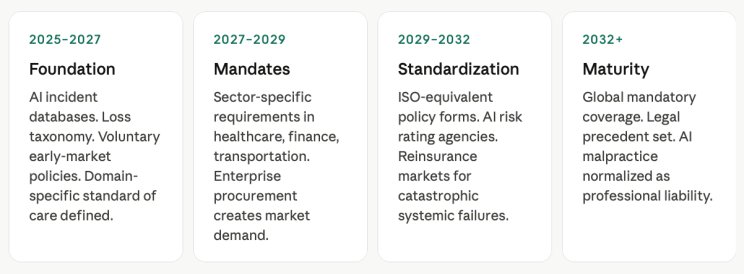
The implementation roadmap
What boards need to do this quarter
The 90-day fiduciary checklist
- Audit your D&O, professional liability, and cyber policies for AI exclusion clauses — they are spreading and most boards are unaware they exist
- Map all AI systems in your organization against EU AI Act high-risk domain criteria — your exposure is almost certainly larger than you think
- Mandate AI audit logs now — the absence of documentation will be treated as evidence of negligence in future litigation
- Add AI malpractice coverage requirements to vendor contracts — this creates market demand and protects you simultaneously
- Engage a specialty insurer about voluntary AI liability coverage — early adopters will lock in better terms before mandates make it expensive
The bottom line
Medical malpractice insurance did not eliminate error in medicine. It created the financial architecture that made accountability real — and made standards rise because the cost of failure had a clear address.
AI is consequential. AI errors are inevitable. The victims are real. The question is not whether a structured AI accountability framework will exist. It is who will build it, who will regulate it, and who will be caught without coverage when it arrives.
The answer to all three questions depends on decisions being made right now — in boardrooms, in regulatory agencies, and in the handful of specialty insurers bold enough to write the first real policies into a market that doesn't yet know it needs them.
Mugur Tolea is a Technology Executive with direct experience designing and deploying AI systems at scale. This article is intended as a strategic framework for discussion and does not constitute legal, insurance, or financial advice. Organizations should consult qualified legal counsel and insurance professionals regarding their specific circumstances.
Sources and data referenced: Stanford AI Index Report 2025 | Swiss Re Institute Sonar 2024 | American Bar Association AI Insurance Survey 2025 | Relm Insurance Product Launch 2025 | EU AI Act (effective February 2025) | ISO Generative AI Policy Exclusions 2025 | Medical Economics AI Malpractice Report 2025 | Harvard Law School Corporate Governance Blog 2025 | Lawfare Media AI Insurance Analysis 2025 | Mordor Intelligence AI Insurance Market Report 2025 | The Business Research Company Insurance Market Report 2025 | AI Incident Database / Stanford HAI | Responsible AI Labs Safety Incident Analysis 2025