

A note on vantage point. I am not a physician. I am a technology and operating-model executive who has spent years working alongside physicians, medical practices, and healthcare leaders, and comparing how their organizations run with how complex professional institutions run in financial services, technology, and digital media. This is the view of a systems analyst who has been trusted to see the machinery up close, and who admires what he has seen.
The Quiet Room
There is a particular kind of silence in a medical committee room. A physician asks a question that is not clinical and not scientific. It is a governance question: how a decision was made, who has the information, how a process works. The room goes still, and a few seconds later the meeting moves on.
That silence is information. It tells a group where its governance is today, and it points to the next improvement. Medicine already treats an unexpected finding as a reason to look closer. A group that treats a quiet room the same way learns quickly.
The central idea of this article is simple. Governance is the least-trained competency in medicine, and it is also among the most improvable. Physicians have spent generations making clinical care measurable and teachable. The same habits, applied to how groups decide, share information, and develop leaders, produce organizations that are fairer, faster to adopt good technology, and better places to practice.
The Architecture of Openness
Every committee has an architecture: a set of habits that decide what happens when a member raises something new. Most groups never design it. They inherit it, and it runs for years without anyone examining it.
The architecture of openness has three parts, each a small habit any chair can begin at the next meeting. The first takes place where everyone can see it, because the seventy or eighty physicians watching a committee notice how the first hard question is received. That moment sets the norm for the whole group.
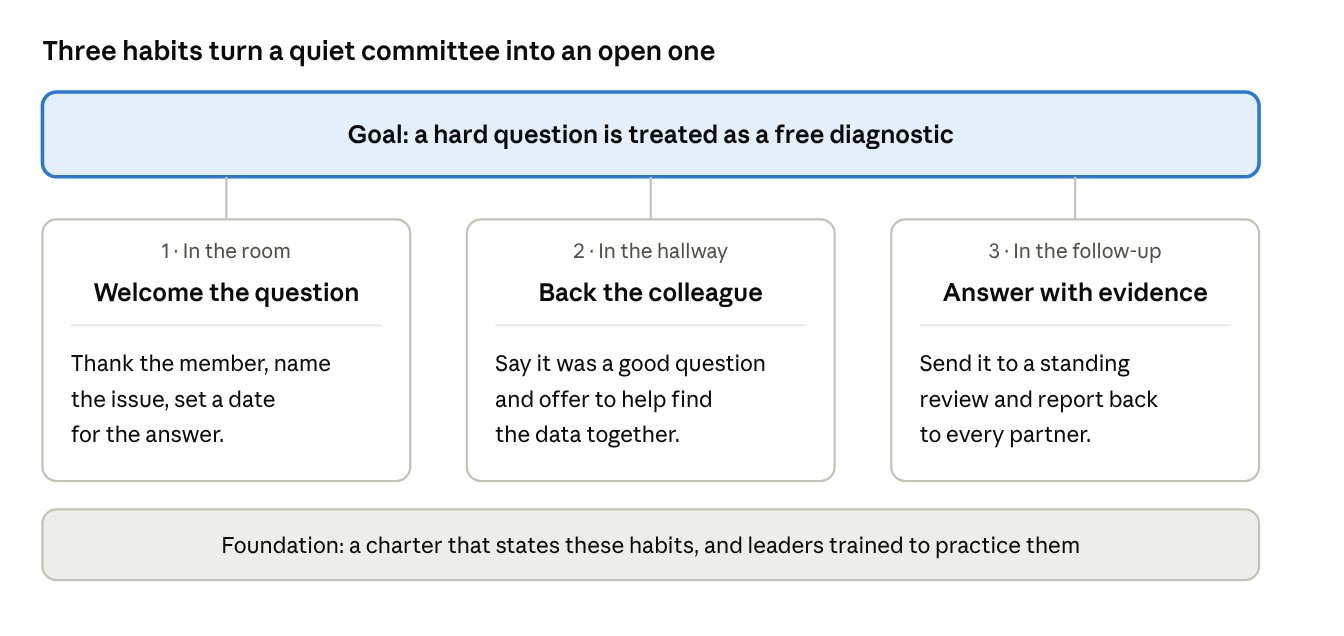
Each habit is modest on its own. Together they tell every member, in the room and afterward, that a good question is welcome here.
Closing the Governance Gap
Medical groups present themselves as collegially governed: decisions come through representative committees, every partner has an equal voice, and concerns reach the table through transparent channels. In the best groups that description is accurate. In many others there is a gap between the formal structure and the informal one.
The committees exist. The meetings happen. The minutes are kept. But some of the most consequential conversations, such as who learns about what and when, still travel through the informal networks that grew up alongside the formal ones. Those networks were built when it was simply assumed that the people who needed to know, knew. Nobody designed them to leave anyone out, and nobody redesigned them as groups grew larger and more diverse.
The opportunity is to bring those conversations into the light. Four practices do most of the work:
- Publish the calendar of decisions. Partners can see what is coming before it is decided.
- Share information once, to everyone. A common channel for announcements removes the advantage of proximity.
- State decision criteria in writing. People can see how a choice was made, even when they would have chosen differently.
- Close the loop. Every question raised in committee gets an owner and a date for the response.
Transparency also protects the group. Groups that keep decisions and data visible tend to find and fix problems earlier, while they are still small. That is a risk-management benefit as much as a fairness benefit.
What Openness Returns
The return on an open committee is measured first in people. Physicians who feel safe asking questions stay engaged, contribute more, and carry less of the occupational stress that comes from second-guessing whether it is worth speaking up. Research on physician burnout consistently shows higher baseline stress among some groups of physicians, which makes psychological safety a practical retention strategy as well as a cultural goal.
The return reaches patients as well. The National Academy of Medicine's 2017 work on clinician well-being links physician distress to narrowed attention and a lower willingness to raise safety concerns, which are the very behaviors that protect patients. A group that is easy to speak up in is a group where safety concerns surface early. In that sense, governance is a patient-safety intervention.
Incentives are the lever. In many groups the cost of a hard question lands on the person who asks it, while the benefit is shared by everyone. Good design reverses that. When answering a question is easier than avoiding it, and when raising one is recognized as service to the group, questions arrive earlier and cheaper. Three small changes help:
- Name a rotating "question owner" in each committee to track every open item.
- Recognize constructive dissent in leadership reviews.
- Include a governance question in the annual partner survey and publish the results.
The Leadership Education Gap
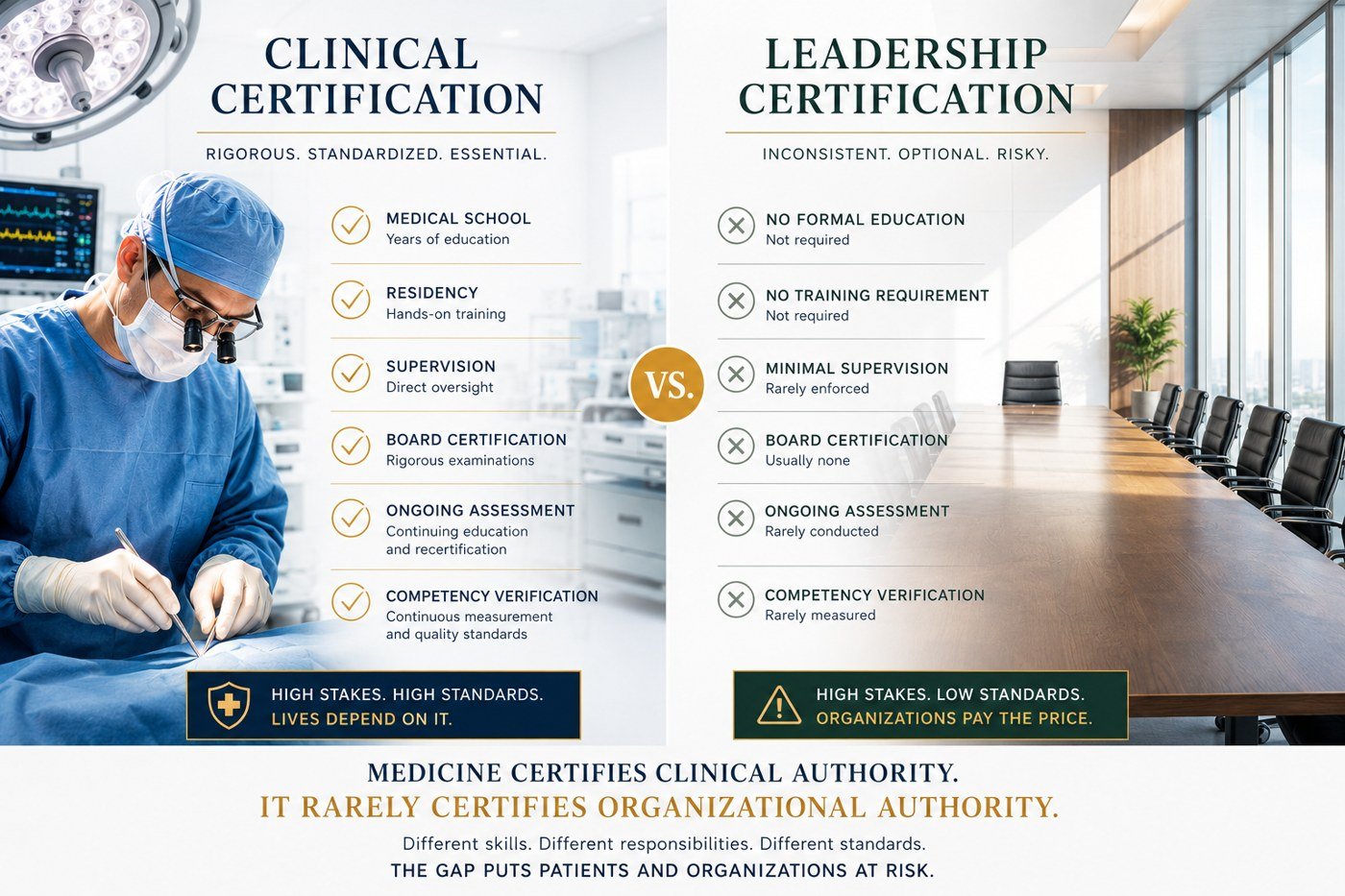
Why do some groups struggle with governance while others thrive? The instinctive answer is individual: a matter of personality or temperament that better hiring might have screened for. The evidence points elsewhere. This is a training gap, not a character gap, and training gaps can be closed.
Consider what medicine does well. It builds clinical skill through years of graduated responsibility under expert supervision, and it certifies competence before independence. The organizing principle is so basic that it is rarely stated: no one practices on patients until they have shown they can do so safely.
Now consider how physicians prepare to lead organizations. A physician who becomes a department chair, committee chair, or medical director usually arrives on the strength of clinical excellence and the trust of colleagues, which are exactly the right reasons. The role, though, calls on a different toolkit that medical training rarely covers. The curriculum section below sets it out.
Medicine would never certify a surgeon after a weekend retreat. Leadership roles with authority over scheduling, compensation, partnership, and process deserve a preparation path of their own, and the tools for building one already exist: physician-leadership programs, executive education, peer cohorts, and structured mentorship.
The pipeline matters too. The AAMC's 2021 data show women have made up nearly half of medical school graduates for over a decade, yet remain underrepresented in chair and medical-director roles. A visible, structured route into leadership is how a group turns its full talent base into its leadership bench. A group that invests here gains twice: current leaders become more effective, and the next generation sees a credible path forward.
What Good Looks Like
Functional governance is not an abstraction. It is a set of concrete, achievable practices that the medical system already has the resources and the precedent to adopt. None of these is utopian. All of them are within reach of a group that decides to begin.
Transparency as the default. Every partner can see, without having to ask, the governance charter, the decisions made in committee and the criteria behind them, quality and performance data, and the record of committee participation. Opacity should require a reason. Openness should be the structural starting point.
Leadership certification that means something. Before taking on authority over scheduling, hiring, or partnership decisions, a physician demonstrates competence in the skills those roles require: governance, ethics, conflict management, and systems thinking. The assessment is conducted by people qualified to judge it and is renewed over time. Medicine certifies clinical competence before granting clinical authority, and the same logic can apply to organizational authority.
A regular governance review. Once a year, at minimum, the group reviews its own governance the way it reviews quality: committee effectiveness, decision cycle times, partner engagement, and how information flows. An outside reviewer adds perspective. The findings are shared with every partner, along with the group's plan for improvement.
Psychological safety as a patient-safety metric. Healthcare organizations spend considerable effort measuring infection rates, adverse events, and readmissions. Very few measure whether physicians feel safe raising a concern. The research on psychological safety is consistent: people who do not feel safe speaking up are less likely to raise problems, and problems that go unraised in clinical settings can become patient-safety events. Measuring and reporting on that connection makes the value of openness visible and actionable.
A Leadership Curriculum Medicine Can Build
If the gap is one of training, the solution includes something medicine has never fully attempted: a defined, assessed curriculum for physicians who lead other physicians. The competencies are well understood. What the profession can add is the commitment to teach them with the rigor it brings to clinical practice. Six modules cover the core.
- Governance and fiduciary responsibility. What it means to govern: decision rights, documentation, and what partners are owed in transparency. In the AI era: sets the approval path and accountability for every new AI tool.
- Organizational psychology and power dynamics. How informal networks form, how authority shapes perception, and how to keep dissent productive. In the AI era: new tools redistribute information and influence, so leaders need to see how.
- Conflict management and negotiation. Turning disagreement into a solvable problem with established frameworks. In the AI era: adoption brings competing priorities that need skilled resolution.
- Ethics, financial stewardship, and accountability. The line between the organization's interests and any individual's, and the financial literacy to see it. In the AI era: vendor contracts, data use, and responsibility for tool outputs all sit here.
- Systems thinking and inclusive design. How structures produce outcomes no one chose, and how to redesign them so opportunity reaches everyone. In the AI era: lets a group design workflows so the benefits of new tools are shared.
- AI and data literacy. How to evaluate a tool, validate it locally, monitor it after launch, and protect patient data. In the AI era: the foundation for adopting AI quickly and safely.
The knowledge exists, and so do the assessment tools. What the profession can contribute is the institutional will to treat governing a physician group as a competency: demonstrated before it is exercised and renewed over time.
A Governance Maturity Model for Physician Groups
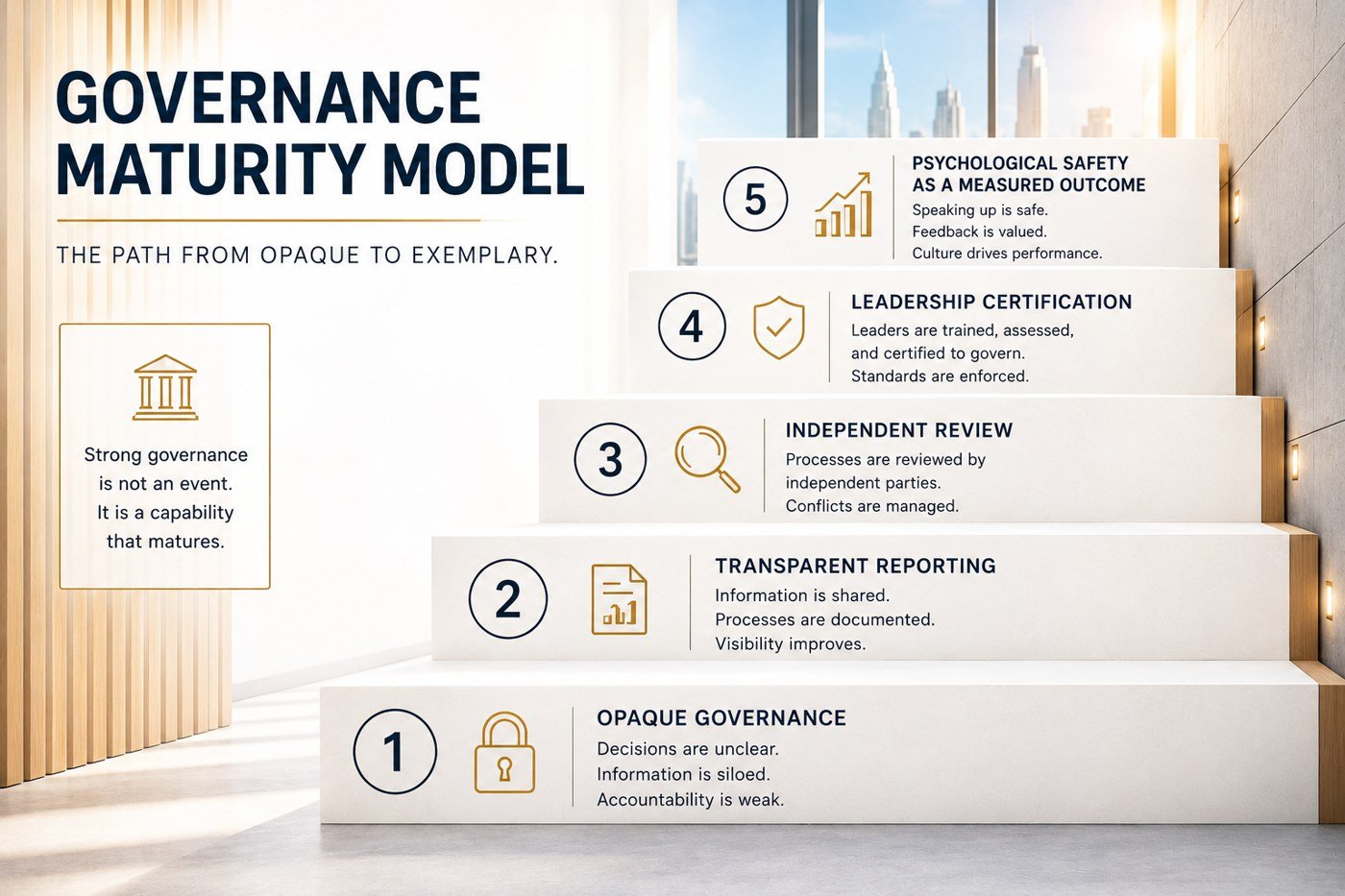
For the executives, medical directors, and board members asking where their organization stands, this framework offers an honest diagnostic. It is not a certification standard. It is a mirror, and its message is that strong governance is not an event. It is a capability that matures.
Level 1: Opaque Governance. Decisions, criteria, and committee outcomes are not yet shared systematically with partners. Information moves through informal networks, and questions raised in committee are handled case by case. This is the natural starting point for any group that grew faster than its structures, and it describes a significant number of practices today.
Level 2: Transparent Reporting. The group publishes, at regular intervals, the rules that govern its decisions, the decisions made in committee and the criteria behind them, and key performance data. Partners can see what is happening. They cannot yet shape the process. This is where governance reform typically begins, and where many organizations pause.
Level 3: Independent Review. An independent perspective, such as an outside reviewer or a peer governance council, periodically examines how decisions are made and how well committees function. Findings are shared with all partners, and conflicts of interest are managed openly. The group learns from its own process.
Level 4: Leadership Certification. Physicians demonstrate, through a formal assessment, that they have the competencies a leadership role requires before they take on governance authority. Certification is treated as a professional standard, renewed over time.
Level 5: Psychological Safety as a Measured Outcome. The group tracks and reports the conditions that let physicians raise concerns early. Psychological safety is treated as a patient-safety metric. The board reviews it, leadership is accountable for it, and its link to clinical quality and organizational integrity is well understood.
A substantial number of groups operate at or near Level 1 or 2. Level 3 is within reach of any group that decides to begin. Levels 4 and 5 are the frontier, and the AI era gives groups a strong, practical reason to move toward them. The momentum is building.
The Board as Partner
Governance maturity does not live only in committees. It also depends on oversight. In well-functioning organizations, boards exist because institutional power benefits from a second set of eyes. Their role is not ceremonial. It is structural accountability: confirming that the people exercising authority are doing so within clear boundaries, and giving someone with standing the information to act early.
That role is only as strong as the information a board receives. Many boards see aggregate metrics, summaries, and leadership narratives. These are useful, and they can be complemented. A board dashboard that adds a few governance indicators, such as partner engagement results, decision cycle times, leadership-development progress, and oversight of new AI tools, gives directors a fuller picture and gives leaders a way to show what is working.
High-reliability industries offer a model. Aviation and nuclear power actively look for weak signals before they become failures, and they reward the people who surface them. A physician who asks a governance question is doing the same thing for the group. Treated as an early-warning system, those questions help a board act while problems are small and inexpensive to fix.
Boards also have a natural opening in AI. Questions of risk, data, accountability, and patient safety are squarely in their remit, and a board that asks them early helps the whole group adopt new tools with confidence.
Why the AI Era Raises the Stakes, and the Rewards
AI is arriving in medical practices through many doors at once: ambient documentation, coding and billing support, scheduling, patient messaging, imaging assistance, and analytics. Each tool promises real relief from administrative load. Each also raises governance questions that a group must answer before the tool can deliver on that promise.
- Who decides which tools are adopted, and by what criteria?
- Who is accountable when a tool's output affects care or revenue?
- How is performance monitored after go-live, and who sees the results?
- How are partners trained, and how do all of them gain equal access to the benefits?
- How is patient data protected, and how is consent handled?
Groups at levels 1 and 2 tend to answer these questions tool by tool, under vendor timelines. Groups at levels 3 through 5 answer them once, as a standing capability: an intake process, an evaluation checklist, a monitoring routine, and a trained group of physician leaders who own it. Published frameworks, such as the NIST AI Risk Management Framework and the work of the Coalition for Health AI, give a solid starting vocabulary.
The opportunity is also cultural. AI will make information about operations, workload, and opportunity easier to produce and share than ever before. A group that already values transparency will use that capability to become fairer and more efficient. A group that does not will find that the tools surface questions it is not yet ready to answer. Governance maturity decides which of those two futures a group gets.
There is a practical dividend as well. Physicians carry a heavy administrative load, and the tools that could lighten it are only as trustworthy as the structures around them. Good governance is how a group earns the confidence to adopt them quickly and safely.
A Practical First 90 Days
Any group, at any level, can begin now. A sensible sequence:
- Days 1 to 30: Assess. Ask partners to place the group on the maturity model, area by area, anonymously. The spread of answers is itself a finding.
- Days 31 to 60: Make one thing visible. Choose a single flow of information, such as committee agendas and decisions, and make it reach every partner at the same time through a shared channel.
- Days 61 to 90: Invest in leaders. Fund a leadership-development track for current and emerging physician leaders, covering governance, negotiation, and AI literacy.
- Throughout: Set a review rhythm. Choose two or three governance indicators and review them each quarter, the way the group reviews quality metrics.
None of this is expensive, and none of it needs a crisis to justify it. It needs a decision to treat governance as a discipline.
An Invitation
Physicians have spent a century building the most rigorous learning culture in any profession. The same culture, pointed at how groups govern themselves, can produce organizations that are fairer, faster to adopt good technology, and better places to practice medicine.
The AI era will reward the groups that do this early. The work is not glamorous, and it begins with a simple question: where are we today, and what is our next level? Every group can answer it, and every group can improve. The knowledge exists, the assessment tools exist, and the examples exist. What medicine needs now is the will to apply them to leadership with the same rigor it applies to clinical care.
Selected References
- Lautenberger DM, Dandar VM. The State of Women in Academic Medicine: Exploring Pathways to Equity. Association of American Medical Colleges (AAMC). 2021.
- Shanafelt TD, Noseworthy JH. Executive Leadership and Physician Well-being: Nine Organizational Strategies to Promote Engagement and Reduce Burnout. Mayo Clinic Proceedings. 2017;92(1):129-146.
- Edmondson AC. The Fearless Organization: Creating Psychological Safety in the Workplace for Learning, Innovation, and Growth. Wiley, 2018.
- Dyrbye LN, Shanafelt TD, Sinsky CA, et al. Burnout Among Health Care Professionals: A Call to Explore and Address This Underrecognized Threat to Safe, High-Quality Care. NAM Perspectives. National Academy of Medicine, 2017.
- Appelbaum NP, Appelbaum EN, Friedman J. Physician Leadership Development: A Scoping Review. Journal of Healthcare Management. 2021;66(3):183-200.
- Pointer DD, Orlikoff JE. Board Work: Governing Health Care Organizations. Jossey-Bass, 1999.
- Leape LL, Shore MF, Dienstag JL, et al. Perspective: A Culture of Respect, Part 2: Creating a Culture of Respect. Academic Medicine. 2012;87(7):853-858.
Mugur Tolea is the founder of Neural Kinetic, an AI strategy advisory practice.